For commerce students planning a strong finance career in 2026, the biggest confusion is often between CMA (Certified Management Accountant) and CFA (Chartered Financial Analyst). Both are globally respected finance certifications, yet their career paths, skill focus, difficulty level, and job outcomes are completely different.
This detailed guide is specially written for commerce students in India, Bihar, and Patna who are searching for answers like: “CMA vs CFA which is better after commerce?”, “CMA course after 12th – is it worth it?”, and “Best finance career option in 2026”.
Understanding the Core Difference Between CMA and CFA
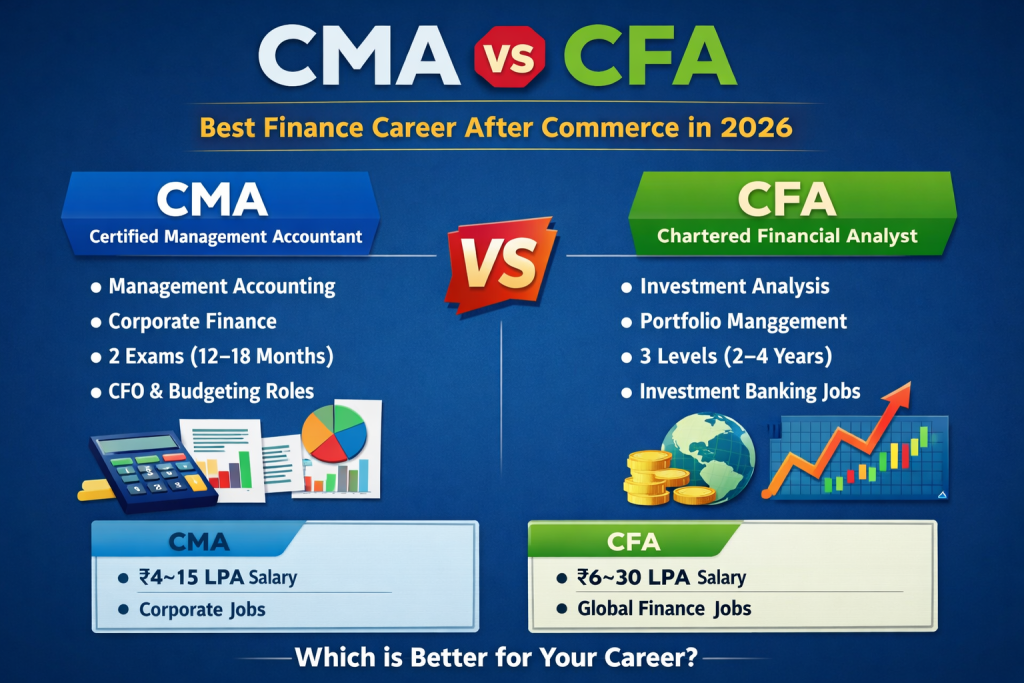
The fundamental difference between CMA and CFA lies in how finance is applied. CMA focuses on internal business decision-making, while CFA focuses on external investment and market analysis.
| Factor | CMA | CFA |
|---|---|---|
| Primary Focus | Management Accounting & Corporate Finance | Investment & Financial Markets |
| Ideal Career | CFO, Finance Manager, FP&A | Investment Banker, Portfolio Manager |
| Exam Levels | 2 Parts | 3 Levels |
| Average Duration | 12–18 months | 2–4 years |
| Difficulty | Moderate | High |
CMA Course After 12th Commerce – Complete Explanation
One of the biggest advantages of CMA is that students can start preparation after 12th commerce. With the right mentorship, students can build strong foundations in accounting, costing, and finance while completing graduation.
The CMA syllabus is divided into two parts:
- Financial Planning, Performance & Analytics
- Strategic Financial Management
These subjects are directly aligned with real corporate roles, which is why CMA professionals are highly valued in MNCs, manufacturing companies, and consulting firms.
Note for Patna & Bihar students: Choosing structured coaching like Sukrishna Commerce Classes best CMA Coaching in Patna significantly improves pass rates and conceptual clarity.
CFA Course Details – What Makes It Globally Powerful
The CFA program is globally known for its depth and rigor. It focuses on investment analysis, portfolio management, equity valuation, fixed income, derivatives, economics, and ethics.
CFA is divided into three levels:
- Level I – Fundamentals of finance and investment tools
- Level II – Asset valuation and financial analysis
- Level III – Portfolio management and wealth planning
In 2026, CFA has increased emphasis on data analytics, ESG investing, and risk management, making it extremely relevant for global finance careers.
CMA vs CFA Salary in India (2026 Updated)
| Career Stage | CMA Salary (₹) | CFA Salary (₹) |
|---|---|---|
| Entry Level | 4–7 LPA | 6–10 LPA |
| Mid Level | 8–15 LPA | 10–25 LPA |
| Senior Level | 20–30+ LPA | 30–50+ LPA |
While CFA offers higher global salary potential, CMA often delivers faster career stability and leadership roles in India.
Which Is Better CMA or CFA After Commerce?
There is no single “best” course for everyone. The correct choice depends on your mindset:
- Choose CMA if you want corporate finance, budgeting, strategy, and CFO-track roles.
- Choose CFA if you love stock markets, investments, analytics, and global finance.
Many students even pursue CMA first and CFA later to build a powerful dual-finance profile.
Why Coaching Matters – Patna & Bihar Perspective
Finance certifications are not easy. Success depends heavily on:
- Conceptual clarity
- Exam-oriented preparation
- Mentorship and guidance
Sukrishna Commerce Classes offers specialized CMA coaching in Patna, while Sukrishna Commerce Academy provides structured CFA guidance for commerce students across Bihar.
Final Verdict: Best Finance Career Option in 2026
Both CMA and CFA are elite finance certifications. Your success will depend not just on the course, but on:
- Your interest
- Your discipline
- Your mentorship
- Your long-term career vision
Choose wisely — and start early.